What Happens During a Fire Restoration Project?
The fire is out, but the damage does not stop when the trucks leave. Smoke can travel through rooms that never burned. Soot can settle inside cabinets, HVAC components, and electronics. Water used to put out the fire can begin feeding mold growth within days. Fire restoration is the work of safely addressing all of those problems, then rebuilding the property so it can be used again.
For a homeowner, business owner, landlord, or property manager, the first days after a fire can feel overwhelming. There may be safety concerns, insurance questions, damaged belongings, and pressure to get people back into the building. A qualified restoration team brings order to that situation by handling the project from inspection through cleanup, repair, and reconstruction.
What to Do First After a Fire
Do not enter a fire-damaged property until the fire department or another authorized official says it is safe. Even a small kitchen or appliance fire can leave behind unstable materials, damaged electrical systems, sharp debris, airborne soot, and contaminated water. If the building is open to the elements, it may also need immediate protection from rain, wind, and unauthorized entry.
Once entry is approved, document visible damage with photos and video before moving items, when possible. Contact your insurer promptly and keep receipts for emergency lodging, temporary business arrangements, or other approved expenses. Then call a restoration provider that can respond quickly and coordinate the physical recovery work.
The early goal is not to make the property look better. It is to stabilize it. That can mean securing windows and doors, placing roof tarps, shutting off unsafe utilities, extracting standing water, and setting up equipment to control moisture. Fast action limits secondary damage and preserves more of what can be restored.
How Fire Restoration Moves From Damage to Repair
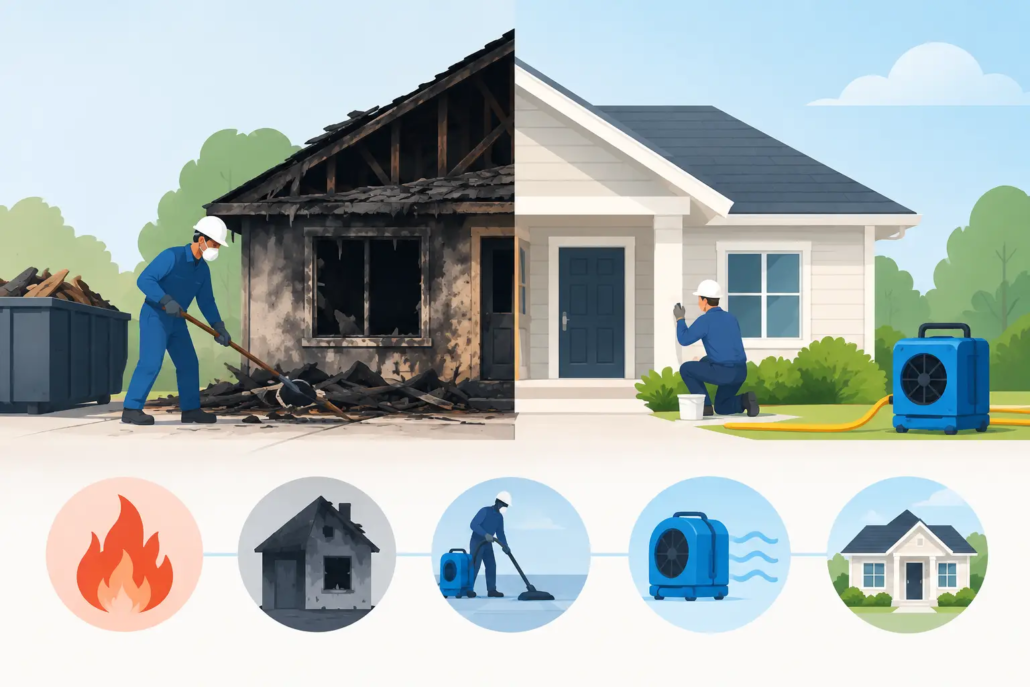
Every loss is different. A contained grease fire may mostly affect one room, while a larger structure fire can require extensive demolition and reconstruction. Still, a complete fire restoration project usually follows a clear sequence.
Inspection and a detailed recovery plan
Restoration begins with a full assessment of the building, not just the charred areas. Professionals look for structural damage, smoke migration, soot type, water intrusion, odor sources, and materials that cannot be safely cleaned. They also identify contents that can be restored, such as furniture, documents, textiles, equipment, or sentimental items.
This inspection informs the scope of work and gives the property owner, insurer, and other involved parties a clearer picture of what comes next. On commercial properties, it can also help prioritize areas that support essential operations, such as offices, patient areas, common spaces, or tenant units.
Emergency board-up, tarping, and water removal
A fire often leaves a property exposed. Broken windows, burned doors, holes in the roof, or damaged exterior walls can allow weather and pests inside. Board-up and tarping protect the building while the larger restoration plan is underway.
Water mitigation is equally urgent. Fire suppression water may be clean, but once it mixes with ash, insulation, drywall, or building debris, it can become contaminated. Extraction, drying, and moisture monitoring help prevent warped flooring, deteriorating drywall, corrosion, and mold growth. Waiting for visible mold is not a sound plan – the moisture problem needs to be addressed first.
Soot and smoke cleanup
Soot is not ordinary dust. It can be oily, dry, acidic, or protein-based, depending on what burned. Using the wrong cleaning method may smear the residue deeper into a surface or permanently damage paint, fabric, and finishes. Restoration technicians use appropriate dry cleaning, wet cleaning, specialized vacuums, and other methods based on the material and type of residue.
Smoke can affect areas far from the fire through air movement, open doors, ductwork, and pressure changes. That is why a room can look untouched yet still smell smoky or have residue on walls, ceilings, and contents. Thorough cleaning may include walls, ceilings, flooring, cabinetry, light fixtures, appliances, and HVAC components when necessary.
Odor removal at the source
Covering fire odor with fragrance does not solve it. Smoke odors linger because microscopic particles remain trapped in porous materials like drywall, wood, insulation, upholstery, and carpet. Effective odor removal starts with removing the source, cleaning affected surfaces, and treating materials with professional equipment and methods suited to the loss.
Sometimes cleaning can save a material. Other times, insulation, carpet pad, drywall, or charred framing must be removed because odor and contamination cannot be reliably eliminated. That decision should be based on inspection findings, safety, and the expected result – not simply the lowest initial cost.
Contents cleaning and pack-out
Belongings can be one of the hardest parts of a fire loss. Some items have financial value; others cannot be replaced. A careful contents evaluation separates what can be cleaned and restored from what must be documented as a loss.
For larger projects, a pack-out may be the practical choice. Items are inventoried, carefully moved from the property, cleaned or stored as appropriate, and returned when the rebuilding work is complete. This also gives reconstruction crews the access they need to work safely and efficiently.
Repairs and reconstruction
Cleanup alone does not return a property to normal. Fire restoration may move into demolition, framing, drywall, flooring, painting, cabinet replacement, electrical repairs, plumbing, and final cleaning. When separate vendors handle every phase, property owners can end up managing multiple schedules, estimates, and points of contact during an already difficult time.
An end-to-end provider keeps the work connected. Renew Cleaning & Restoration can manage emergency mitigation, cleaning, repairs, and reconstruction under one accountable team, so clients do not have to piece the project together themselves. The scope will depend on the damage, but one coordinated process helps reduce delays and confusion.
What Affects Fire Restoration Timelines and Costs?
There is no honest one-size-fits-all answer. A small smoke cleanup may take days, while extensive structural reconstruction can take weeks or months. The timeline depends on the size of the loss, the materials burned, how far smoke traveled, how much water was used, permit requirements, material availability, and insurance approval.
Cost follows many of the same factors. Surface soot removal in one room is very different from cleaning an entire HVAC system, removing contaminated insulation, restoring contents, and rebuilding several rooms. The lowest estimate is not always the best value if it leaves odor sources, moisture damage, or necessary repairs behind. A detailed scope that explains what is being cleaned, removed, repaired, and reconstructed gives everyone a better basis for comparison.
For commercial and multi-unit properties, speed also has an operational cost. A closed office, uninhabitable unit, disrupted clinic, or inaccessible common area can affect revenue, residents, employees, and customers. The right plan balances a fast response with careful documentation, safe work practices, and repairs that hold up after reopening.
Why Professional Cleanup Matters After Even a Small Fire
DIY cleanup can be tempting when flames were limited, but smoke and soot are easy to underestimate. Household vacuums can spread fine particles. Improper wiping can grind residue into surfaces. Disturbing damaged materials without the right protection may expose people to irritants and contaminants.
Professional restoration is especially valuable when there is heavy soot, water damage, electrical damage, HVAC involvement, structural concerns, widespread odor, or a need to coordinate with an insurance claim. It is also the better choice when the property needs to be back in service quickly and safely.
The next step after a fire does not have to be a long list of calls and competing contractors. Start with safety, protect the property from further damage, and get a clear assessment from a team prepared to take responsibility for the whole recovery. With the right help, the focus can shift from what was lost to what can be restored.